
PERSIAN POET QUOTES - HAFIZ
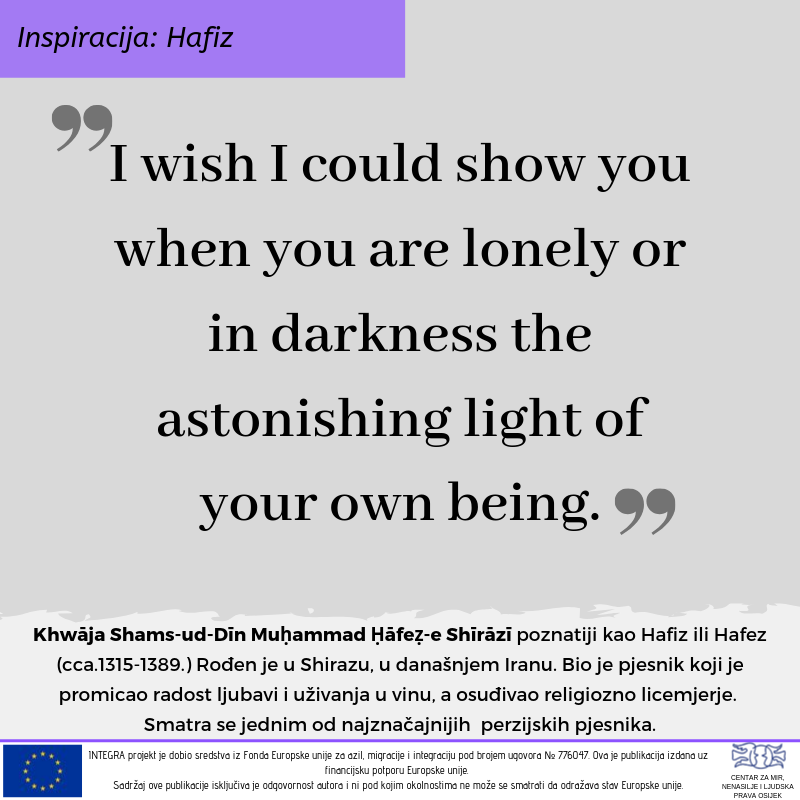
As part of Project #INTEGRA - Integration of Third-country Nationals Through Urban Partnerships, Center for Peace, nonviolence and human rights is running an online campaign, which includes quotes from famous immigrants.
Khwāja Shams-ud-Dīn Muḥammad Ḥāfeẓ-e Shīrāzī also known as "Hafiz",was a Persian poet who "lauded the joys of love and wine but also targeted religious hypocrisy". His collected works are regarded as a pinnacle of Persian literature and are often found in the homes of people in the Persian-speaking world, who learn his poems by heart and still use them as proverbs and sayings. His life and poems have become the subjects of much analysis, commentary and interpretation, influencing post-14th century Persian writing more than any other author.
Hafiz is a rare master of ‘the utility of light’ – or ‘the sun’. And ‘the utility of art’. His poetry bestows its benevolence and ability to comfort, enliven and enrich those in need. In his ghazals he deals with love, wine and taverns, all presenting ecstasy and freedom from restraint, whether in actual worldly release or in the voice of the lover speaking of divine love. Hafiz poems were also admired by such diverse notables as Nietzsche and Arthur Conan Doyle, whose wonderful character Sherlock Holmes quotes Hafiz.
Even Queen Victoria was said to have consulted Hafiz in times of need – which has been a custom in the Middle East for centuries. The Fal-e Hafiz, is an ancient tradition in which a reader asks Hafiz for advice when facing a difficulty or at an important juncture in a client’s life – treating the mystic poet’s books as an oracle and opening them with a deep wish from their soul for guidance.
