
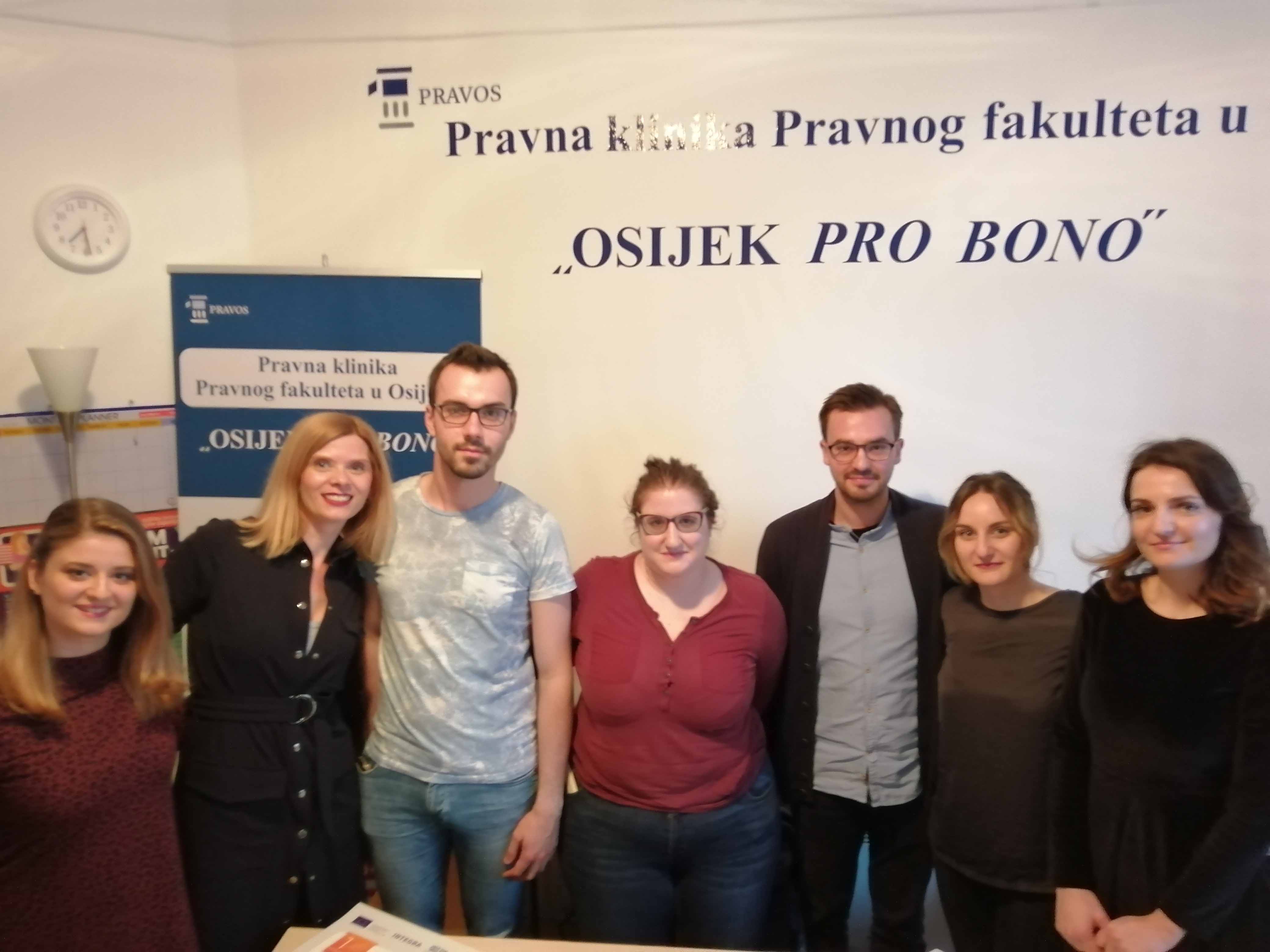
On May 14th Centre for peace- Osijek presented #INTEGRA project to the law students at the Legal Clinic “OSIJEK PRO BONO”. Legal clinic provides essential legal services to different marginalized groups, while at the same time offering students important clinical education experiences. The aim of the Legal Clinic is to systematically develop and improve the practical knowledge and skills of law students and to promote the role of the Faculty of Law in Osijek as socially responsible institutions, particularly interested in promoting equality of all persons and effective realization of rights and legal protection for all persons irrespective of their material status. The legal framework within which the Law Clinic operates is the Law on Free Legal Aid. The law divides legal aid into primary and secondary aid, depending on whether or not the provider of free legal aid is allowed to represent the client before the court. The Law Clinic is authorized to provide only primary legal aid. The students who work there cannot represent clients before the court; what they can do is give out legal advice and general legal information, as well as provide help in drafting documents for use in administrative and other procedures.
The INTEGRA project was presented to the students. While there, thay have discussed about establishing temporary legal advice office for TCN-s in Osijek. The Faculty of Law students are very interested in this topic. Centre for Peace , nonviolence and human rights Osijek provides free legal assistance since 1992 and today it has more than 65,000 clients.

As a part of project #INTEGRA-Integration of Third country nationals through urban partnership, Centre for Peace, nonviolence and human rights Osijek has published a comic book about similarities in differences in Croatian and Persian language that recognizes we are not that different.
Persian also known as Farsi is one of the Western Iranian languages within the Indo-Iranian branch of the Indo-European language family. It is a pluricentric language primarily spoken in Iran, Afghanistan ,Tajikistan Uzbekistan and some other regions which historically were Persianate societies and considered part of Greater Iran. It is written right to left in the Persian alphabet, a modified variant of the Arabic script. Persian language is also a satem language.
Croatian language as a Slavic language also belongs to Indo-European language family and has developed from Old Church Slavonic, an ancient language used, as it`s name implies, in official Church writings of the period. Language arrived in the Balkans region with the migration of the Slavs in the 6th or 7th century. The language eventually evolved into two branches: East South Slavic and West South Slavic. Bulgarian and Macedonian derive from the East South Slavic group and Slovene, Serbian and Croatian are derived from the West South Slavic group. Later in Croatia's eventful history a series of occupying powers-Ottoman, Venetian, Hapsburg, Italian enriched the language with new German, Turkish and Italian words.
